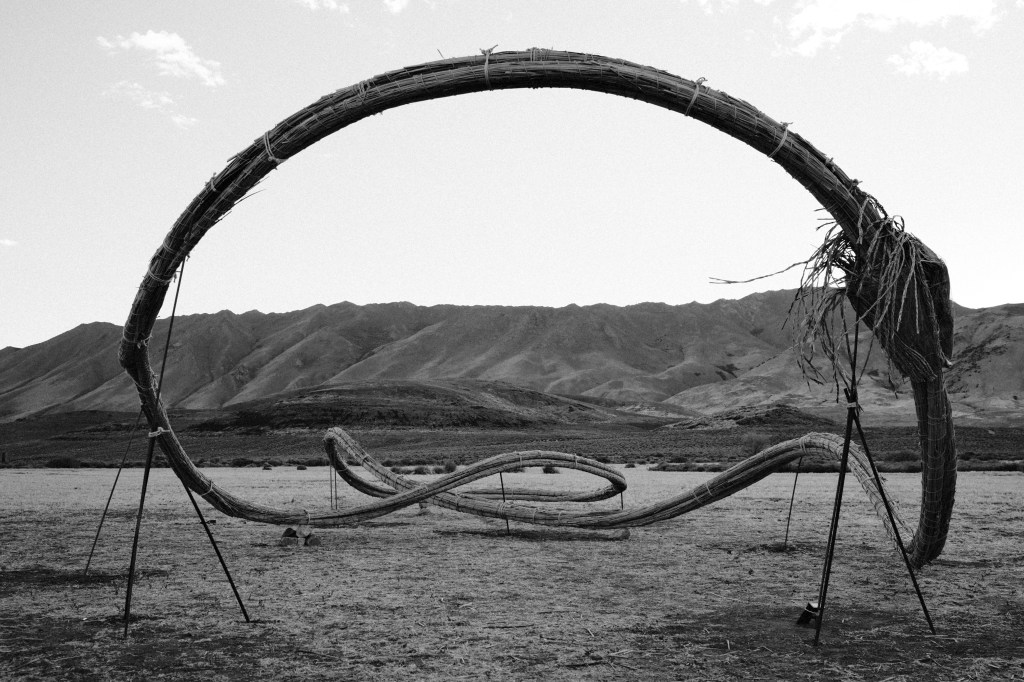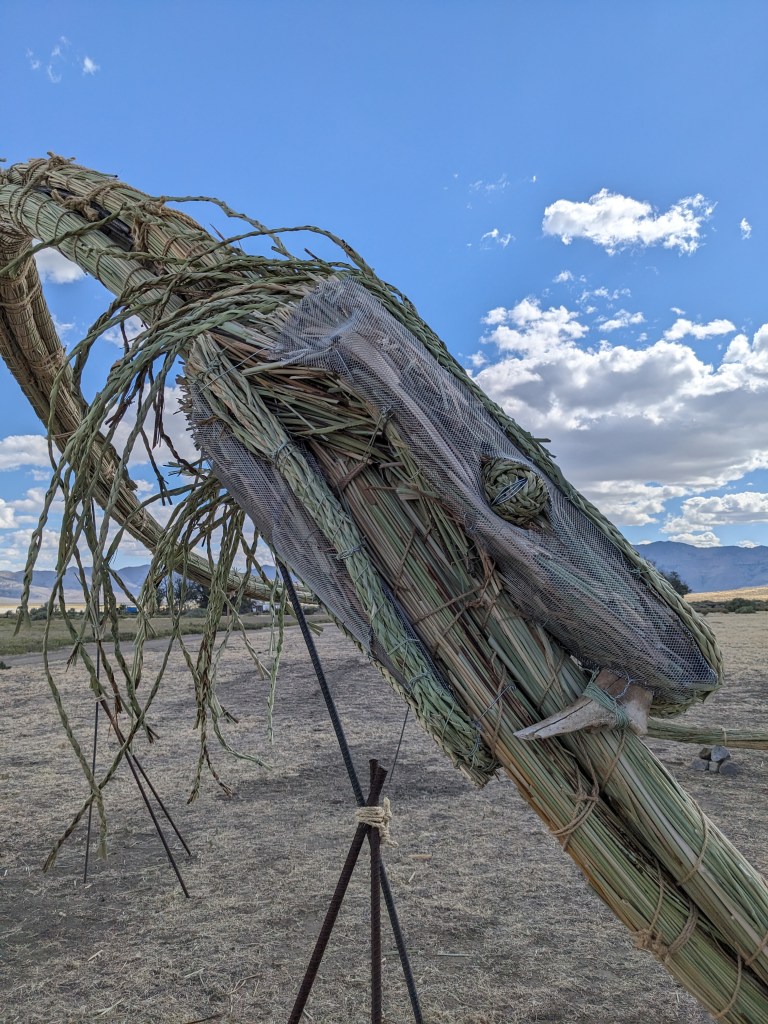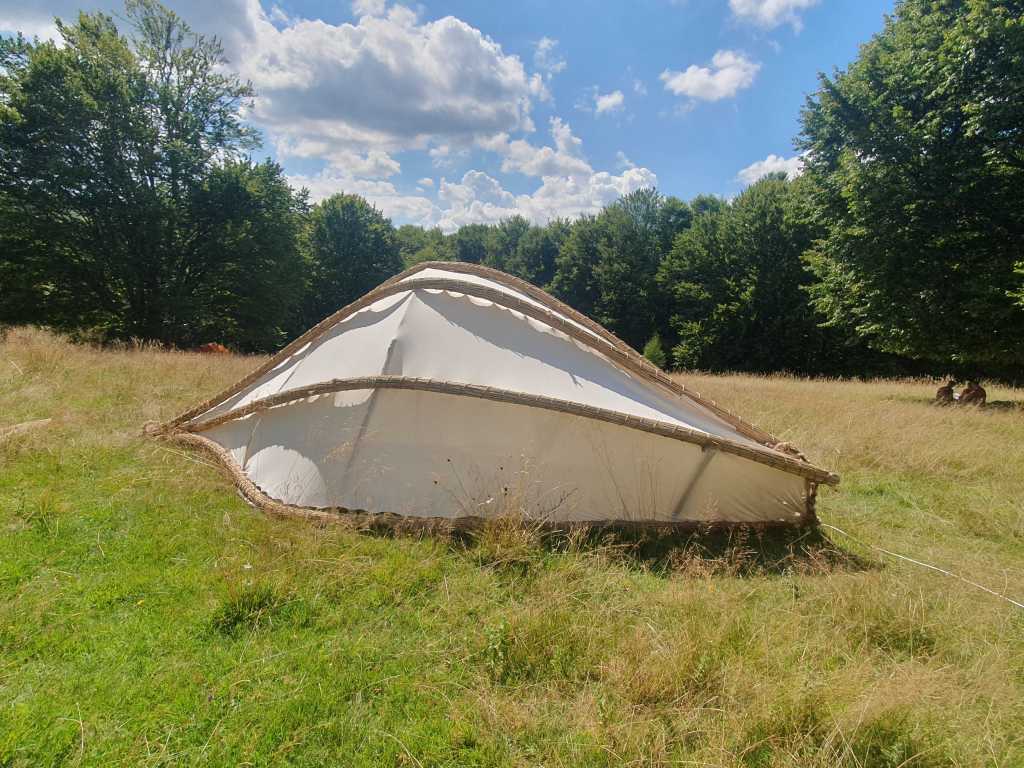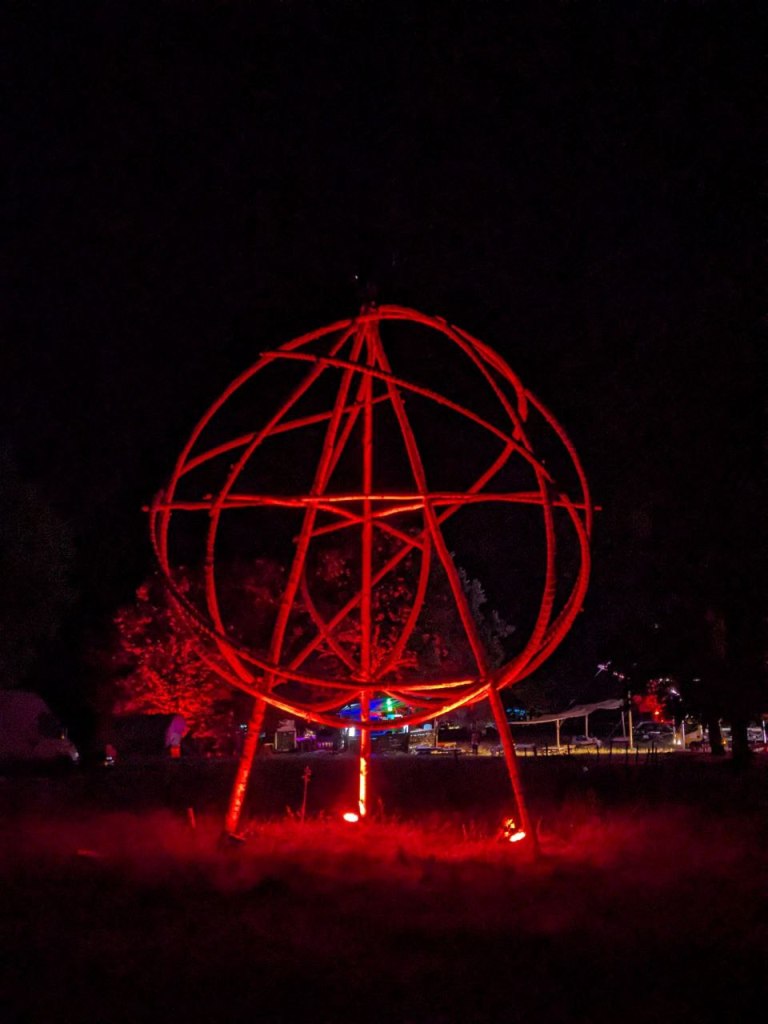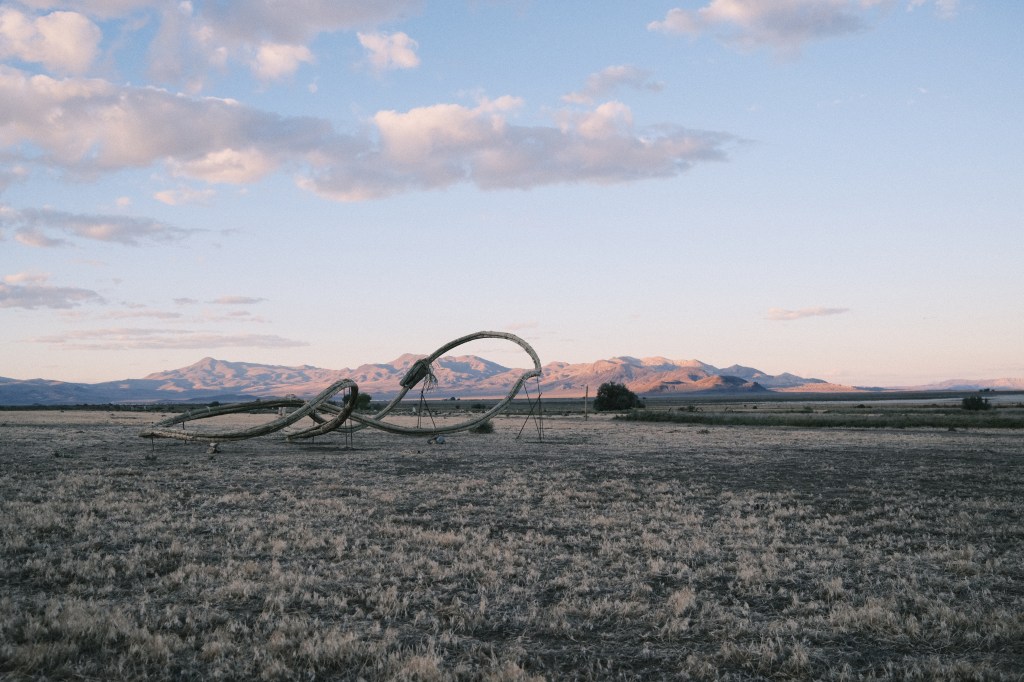
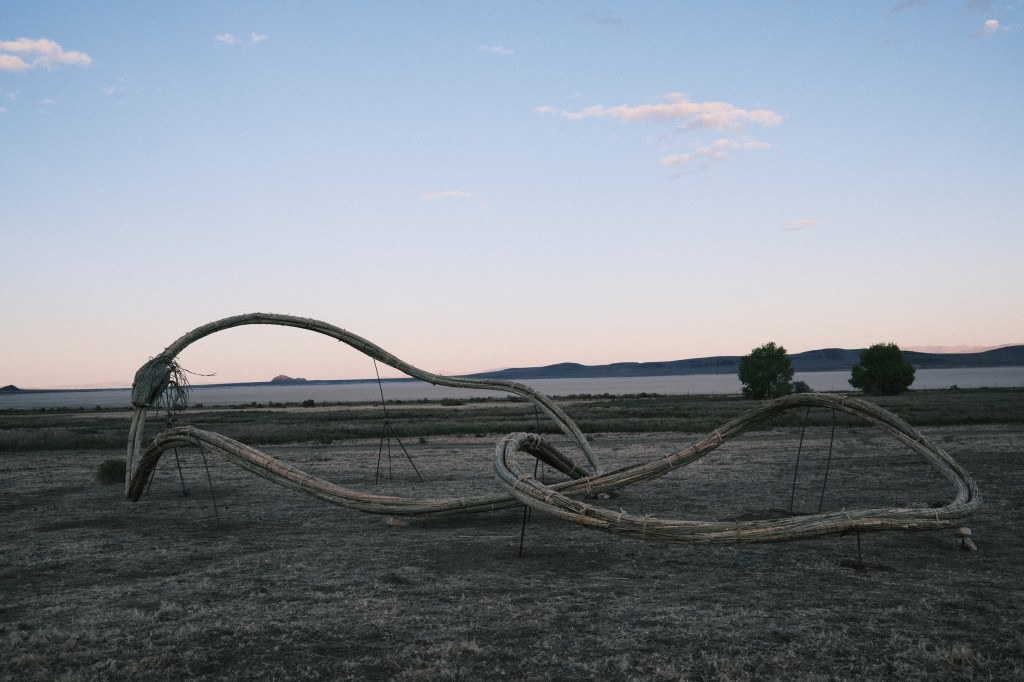
• Permanent Installation for Fly Ranch in collaboration with Emi Watanabe
    Tule grass, cattail, sisal

    Living at Fly Ranch these past weeks was living life one day at a time. One sunrise at a time, one sunset. The first day we arrived, we went to the springs at twilight. I remember the way the light fell onto the orange glazing of the geyser itself, how the spray caught the wind and whipped into a kind of mist that shrouded the top of the geyser. I remember how the light slowly changed as the moon rose and the long, spattered arms of the Milky Way began to spread against the sky, against the backdrop of mountains. We looked into a night sky so deep that I felt a sense of vertigo, falling into the deep black spaces between the stars.
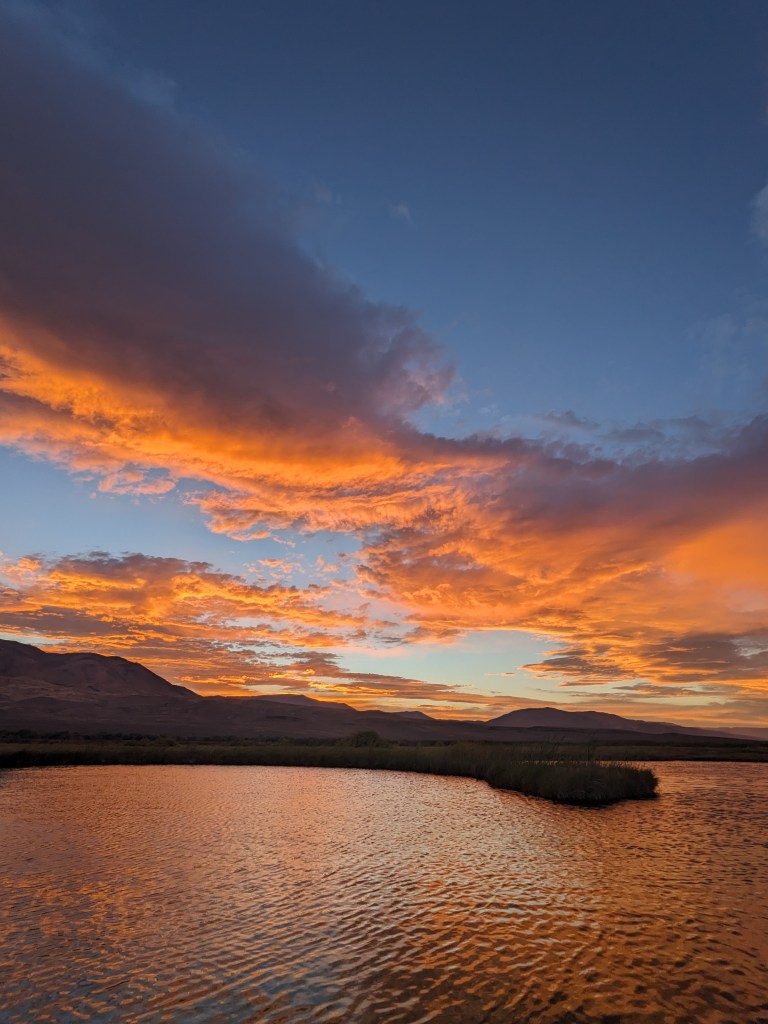
    When I woke the next morning, the sunrise was streaking across the sky in all peach and lavender hues. From above me came the sounds of a black crow high up in the white, bony tree that loomed just a short distance from my tent, next to the seesaws. I would learn that he sat there every morning, around the same time, cawing. It was hard to tell whether this routine had started before we arrived or after, but every morning, like clockwork, I would see him. When he finished his morning calls, he would fly away again and I would know that it was time to start the day.

    There is a small library in the front room of the Operations center, an archive of artifacts from Burning Man lore as well as books about the history of the place. Browsing through these documents, we learned about the history of this site: how the 1997 Burning Man led to visions of this place becoming a year-round site, a long-term home for the culture and community. Fly Ranch as the beginning, and as a vision of a Burning Man future. 

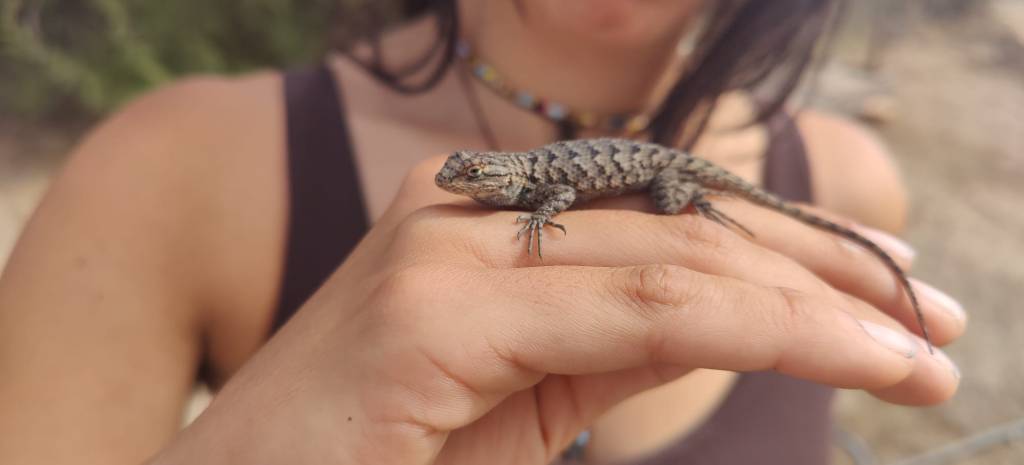
    Unlike the alien moonscapes and dusty expanse of the playa, Fly Ranch has the energy of a place filled with desert life. There are the skittering marks left by lizards across the sand, the tangled webs of black widows in the darker corners, the darting blur of a kangaroo mouse that would come for our small peanut offerings. Blue herons stalk the marshy edges of the reservoir, and at times, the distant yipping of coyotes. 

    In addition to the native life, there are pockets of living things that the community behind Fly Ranch has cultivated. We would walk the spiral garden, grown from Burning Man compost, picking fresh herbs and bright yellow squash that were unbelievably large and sweet. Every morning and evening, the beautiful smell of damp earth burst into the air, as well water drawn from reservoirs deep under the earth flowed into the gardens. Bees came then, to drink their fill from the dripping taps before they returned to their hives hidden under a grove of trees further down the garden path. The people who tend to these lives became our friends, part of our community. We drew sweet, golden honey out of the combs and drank tea together. It felt fitting in this space to think about how our art installation would fit into this larger ecosystem, and important to reflect the mission of regenerative practices and land stewardship that Fly Ranch embodies.
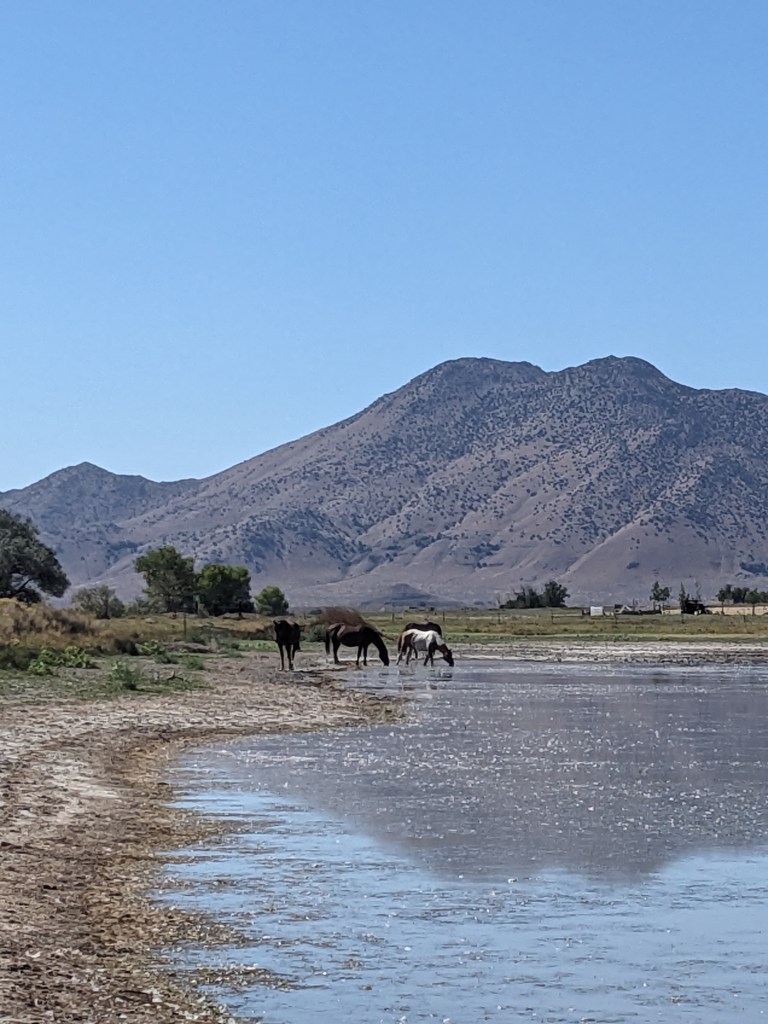
    We harvested tule grass and cattails in the morning to avoid the afternoon sun, with just the birds of the reservoir and some small animal chittering in the depths of the rustling grass somewhere. One day, a pack of young wild horses came to investigate. The most fearless one came right up to us and stared down the vehicle. At that moment, everything was still and we were eye to eye with the nature around us.
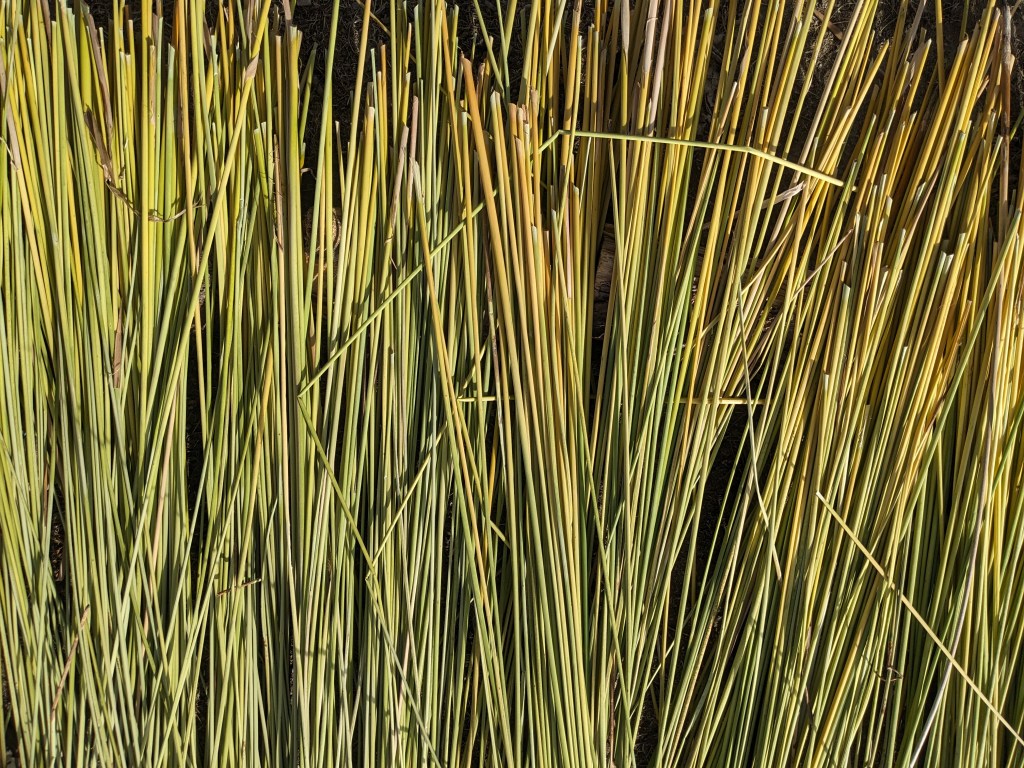
    After we came back, we would lay the grasses out in thin layers to slowly cure. Freshly cut, the color palette was dark green, glossy, and smooth, fading in a bright yellow gradient towards the roots as they hit water level. The colors evolve over the course of days to a pale spring green, and from a distance each spiralled bundle looked almost inorganic, like celadon or some sort of opalescent metal.

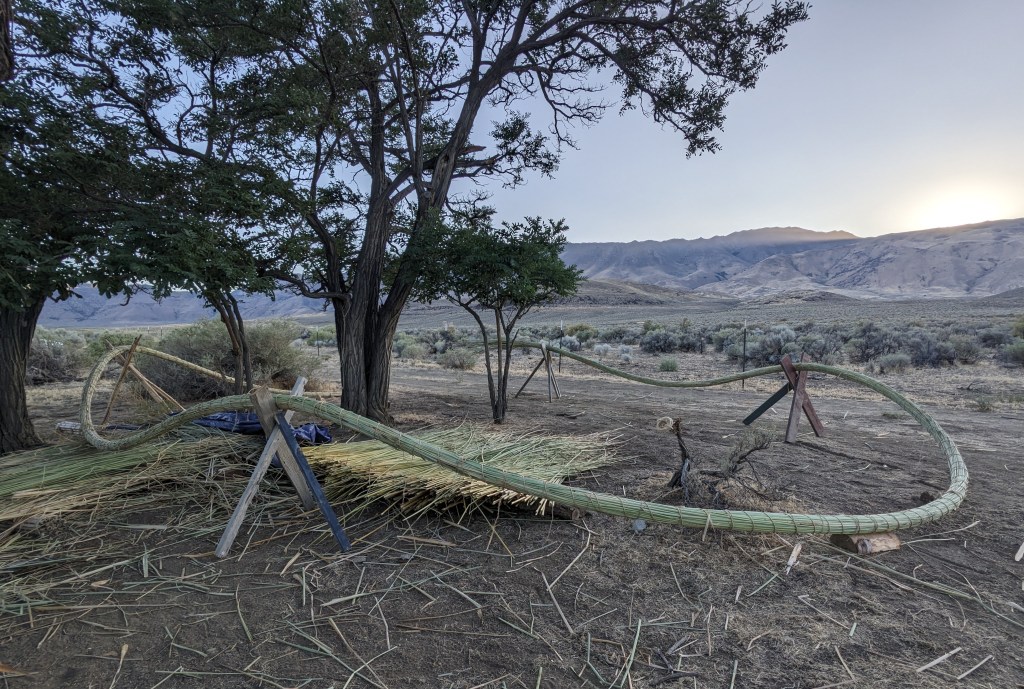
    Spirals upon spirals. It is almost impossible not to enter a kind of meditative state in the process of working with natural materials. The tule and cattail have their own voices. We took fistfuls of grass, so fragile and easily snapped, and wove them into something else. At the location where we harvested, we found the beginnings of weavings, remnants of other creators who had stopped there before us. There is a feeling of bending the elements, listening to how they want to move, and how to push them to the point at which the materials want to stop.

    If you hold a bundle calmly and evenly in your hands, you can feel the gaps in it, like little pockets of lesser resistance: an empty space of imbalance, more prone to breakage when bent. And so we fill them in, space by space. Working with natural materials is a lesson in seeing the diversity in each piece of material given to us by nature, and in creating as balanced a whole as possible, or in going along with the imbalances, to curve there or bend here. There is awareness in this space, or rather a practice of keeping yourself in a state of deep awareness while at the same time surrendering somewhat to the will of the material.
    This was the environment of our process: no power tools, no generators, just the quiet sounds of the desert ecosystem all around us. Even before the harvest, Emi and I had talked for months across time zones about where we would be working and the particularities of tule grass and cattail. We studied the bundling of reeds from the Romanian river delta, techniques from Mediterranean river cane, and reed buildings from South America and Iraq. We visited the Pyramid Lake Museum and learned about the Paiute people and how they had worked with the tule and cattails. Speaking with the docent, we learned that one of his biggest worries was that tribal protections had been created by executive order, and so could just as easily be taken away. I kept thinking about how the land we were on has been stewarded by Numu and Newe people since long before we arrived, people who continue this work today, and about how easily and quickly a balance can be tipped, unmade.
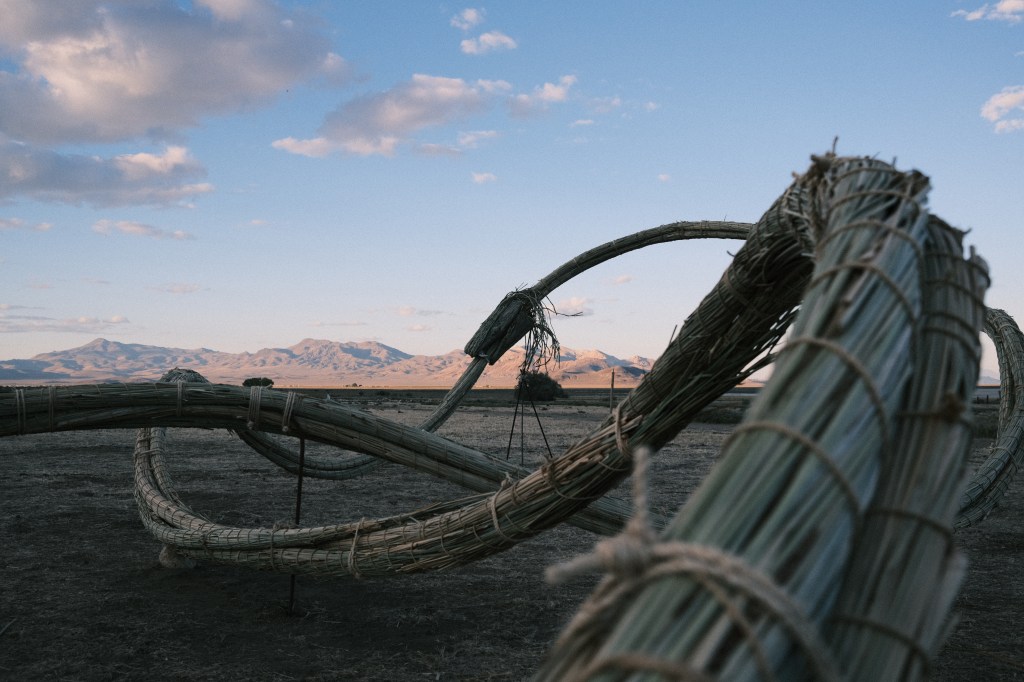
    After the Burn, our friends came to help us. We sat together in a weaving circle, and I felt blessed to have this community, a group of strong sisters. Other artists came as well to install their pieces at Fly Ranch, and as the landscape of art grew more multifaceted and varied around us, so did our community. Each night, we cooked in earthenware pots on the fire and told each other stories of our lives and our dreams, where we had been and where we wanted to go. Ayeda came to us here, with the sound of wind hissing through rippling fields of native grasses, a serpent of this world. She encircles and holds us together, living off the abundance around us. It is said that if the balance is disturbed, she will turn inward and begin consuming her own tail, coil by coil, until the loop closes completely and the world she was holding falls into chaos. There was never anything beneath her but her own body, the delicate balance between the ephemerality of the moments we share and the communities we build, coiling cyclically, meeting infinitely. I hope that walking into Ayeda, you feel held, as we were held.
  • Regina (Dragonfly)

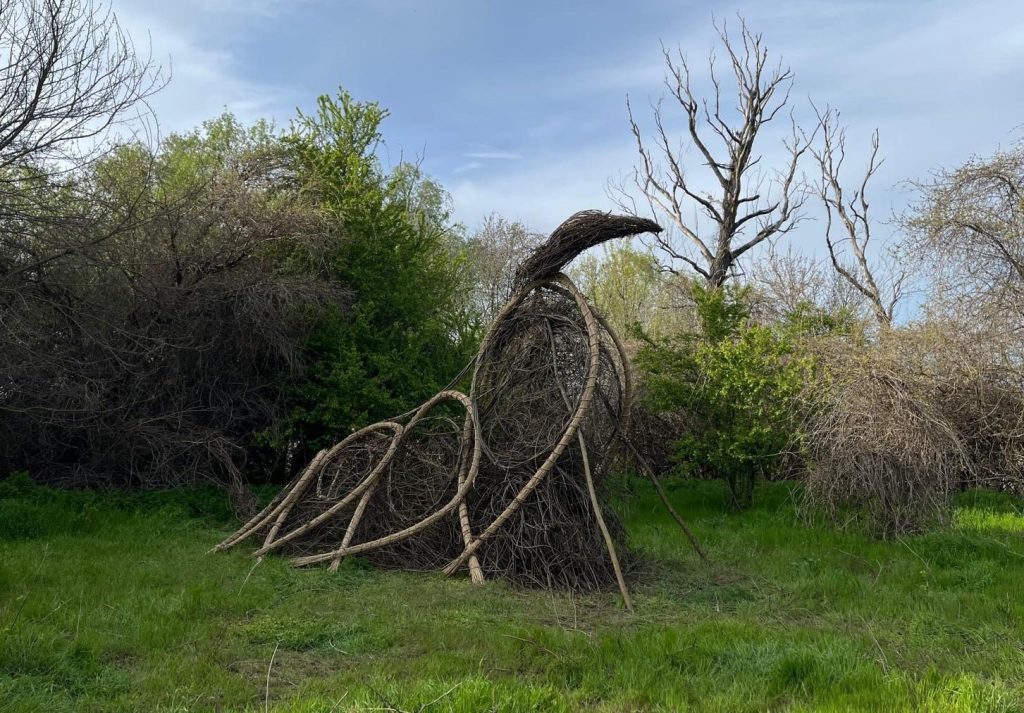
    Permanent Installation for Muzeul Ivan Patzaichin (Romania)
    Reed (Phragmites Australis), Willow (Salix Sp.), Vine (Vitis sp.)

    It began as an idea rooted in the mythological spirit of the Dunărea and the cocoon-like, vine-draped vegetation of the site we were given. It was a dream about an installation which would convey a feeling of the fantastical, but in its essence speak for the land of the Danube Delta where it would be situated and to the people kayaking the local waters who would come to this place to seek inspiration, enjoyment, or a moment of quiet reflection.

    We gathered our materials from the Delta itself: reed, willow, and vines. Bamboo, which served as the framework for the structure, was the only material that didn’t come directly from the Delta, but it was a material I was familiar with and loved for its lightweight nature, durability, and ability to withstand changing environmental factors. Even as we began the build, we felt as though the installation had already started to take on an energy of its own. “Like a cat,” she said, as she smiled gently and wrapped her arms around the stacks of woven reed arches and braided willow circles. “Like a bird, or an insect waiting to take flight,” I thought, as I imagined how the living vines we would braid into the structure would gradually reclaim the natural materials again, back into the land they came from.

    We incorporated aspects of a technique shown to us by a local woman, inserting a willow heart into each reed element for strength and flexibility. We began to imagine how the installation might be able to spark conversations around ecotourism and the importance of protecting this fragile environment. It wasn’t just about creating something beautiful, it was about connecting people to this place, about inviting them to see the Danube Delta and the materials around them through a different lens. The hope was that in sharing its beauty, we could inspire a deeper understanding and respect for the land.

    Working with natural materials is a beautiful process. There is a sense that the materials are a part of the land itself and you are, in a way, invited to collaborate with them rather than control them. When you gather the materials, there is no factory precision; they are imperfect, uneven, each piece different from the last. The reed might bend in unexpected directions, the willow branches may twist with a mind of their own.  But this is what makes working with these materials so humbling. They are not preprocessed, not cut to precision using electric machinery, but living elements of the earth, each one with its own intention.

    The challenge lies in finding balance. How much can you manipulate the material? Can you bend the reed to the shape you have in mind or will it snap if you force it too far? Will the willow branch lose its strength if shaped in a way that goes against its natural form? At some point, the materials resist. But there is a quiet power in human hands, the ability to guide, to coax, and to arrange. You learn the subtle art of listening to the materials, of knowing when to push, and when to step back. There is a kind of grace in this exchange. The materials become something more than they were. And yet, as much as they are shaped, they retain a sense of their own nature. Structures built with natural materials may stand as a testament to an artists skill, but they will also remind you of how little you can truly control when building with materials that are alive in their own right.

    Two days before the end of the build, late afternoon. We had been working on the elements for the installation for a week in the courtyard of the museum, and were finally ready to start installing. We were excited to start, but anxious about the process because there were so many unknowns. Our site was half an hour from the museum by boat, and the elements would therefore need to be transported also via water, balanced carefully over the gunwale of a speeding boat that would wind its way through the reed and tree lined channels of the Delta. Once on-site, we would assemble the pieces onto a spine-like back column and lift up the entire column to set onto the bamboo support structure, with only one tall ladder. All of this would need to be done strongly and quickly, but with enough precise control to ensure that the elements wouldn’t break. 

    The day passed quickly, a roller coaster of emotions that ended on the highest of notes. Everything had worked as we had hoped! There was a perfect moment when we stepped back and saw the evening light fall over the towering structure we had just lifted —a moment of celebration and the gratifying thought of spending the last two days with a golden pace, a leisurely day finishing the rest of the structural notes, the last day working out final details and flourishes.

    But when we returned the next morning, the scene before us was almost unrecognisable. All of the bamboo supports and bracing which were essential to the structure’s stability had been taken. Someone had cut all the ropes securing the bamboo and left them littered on the ground around the structure. The woven reed arches had collapsed to the ground and sagged under their own weight. The bamboo had been entirely removed, even dug up from where we had buried the supporting pieces half a meter in the ground, as though someone had taken the time to disassemble it with purpose.

    The practical consequences were significant. We had to quickly figure out another solution for the supporting structure, and any amount of passing time would mean continued strain on the already strained and breaking reed elements. The delay also meant that we would barely be able to complete the work before the deadline, rather than being able to deliver the project the way we had wanted to. We started to work to recover the elements that had broken and replace the supports that had been taken, but what had happened lingered in the back of our minds, and the air felt heavy and strange. There was loss of trust, a sense of violation, and above all a huge feeling of confusion. Was it a rejection of our attempt to bring attention to the Delta? Or was it something less personal, more deeply rooted in a complex relationship between the locals and the outside world? We had come here with the best of intentions, to work with the land, to learn the people and their heritage, and to help open a dialogue about sustainable tourism. But this act felt like a rejection of all of these ideas, a statement that we weren’t welcome, that outsiders—no matter their intentions—would never have a place among the local community.

    As we tried to recover and keep moving forward, something beautiful happened: a community around us came together to show their support in a huge and meaningful way. A team of Romanian and Roma builders who had just finished another job for the museum, a French student who was in the area doing research for his master’s thesis — these individuals volunteered their time and energy for us, to help us recover what we had lost and realise our vision for the piece. There was something so deeply moving about this gesture, and the experience reminded us that true community bridges all types of diversity, and  is built not only in moments of joy and celebration but especially in times of loss and challenge.

    In the end, we completed the installation on time with the strong support of our friends. It wasn’t as pristine as it could have been, but in a way, the process felt more real. We had come to create a piece of art inspired by fantasy and mythology, but we were reminded that for all its serene beauty— the sunsets and sunrises over misty waters, the flocks of migratory birds and other wetland wildlife inhabiting its ancient waterways— the Danube Delta is not a place that easily accepts outside influence. It is a place that lives by its own rhythms and its own rules, which have been shaped by centuries of isolation and self-reliance. For me, the experience of installation has evolved beyond just a focus on natural materials and sustainable tourism; it has become my own lesson in resilience in the face of challenges and how to accept complexity.

  • River Junk

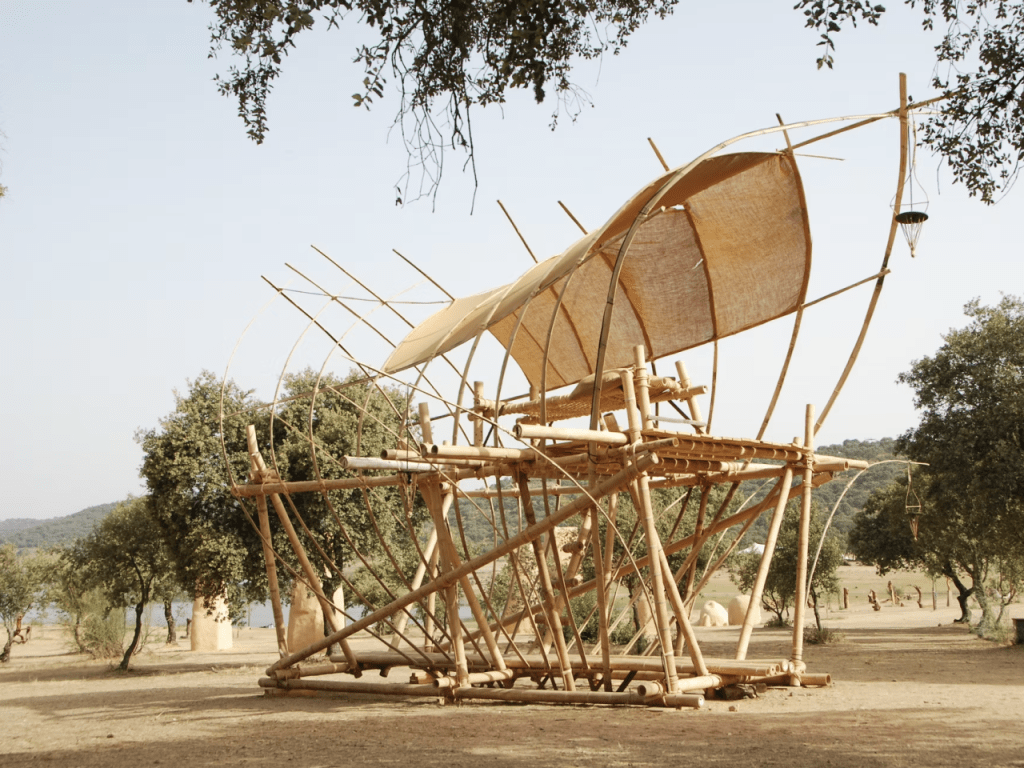
    In collaboration with Joseph Williams (Bamboology) and Catalin Sendresc (Tiny Wunder House)

    Bamboo, unmanila rope, hemp cloth, wood

    Boom Festival, Portugal

  • Cornucopia

    In collaboration with Mafalda Fernandes Bamboo Studio

    Bamboo, hemp rope

    Envision Festival, Costa Rica

  • Cocoon

    Reed (phragmites australis), white birch, hemp rope

    Waha Festival, Romania

    The medium I was given was Phragmites australis, or the common reed. You may have seen this growing on the banks of some lakes or being used for thatching on the roofs of some vintage historical homes.

    While brainstorming what to do with this medium, after a bunch of looking around the internet, I finally found some vernacular architecture from Iraq and Peru — both of which used this kind of reed to create structures like columns for meeting halls, or boats. It was quite difficult to find anything more than a few photos/a youtube interview or two, with someone working in the background, but I did gather a few ideas for things that I wanted to try when i got on site.

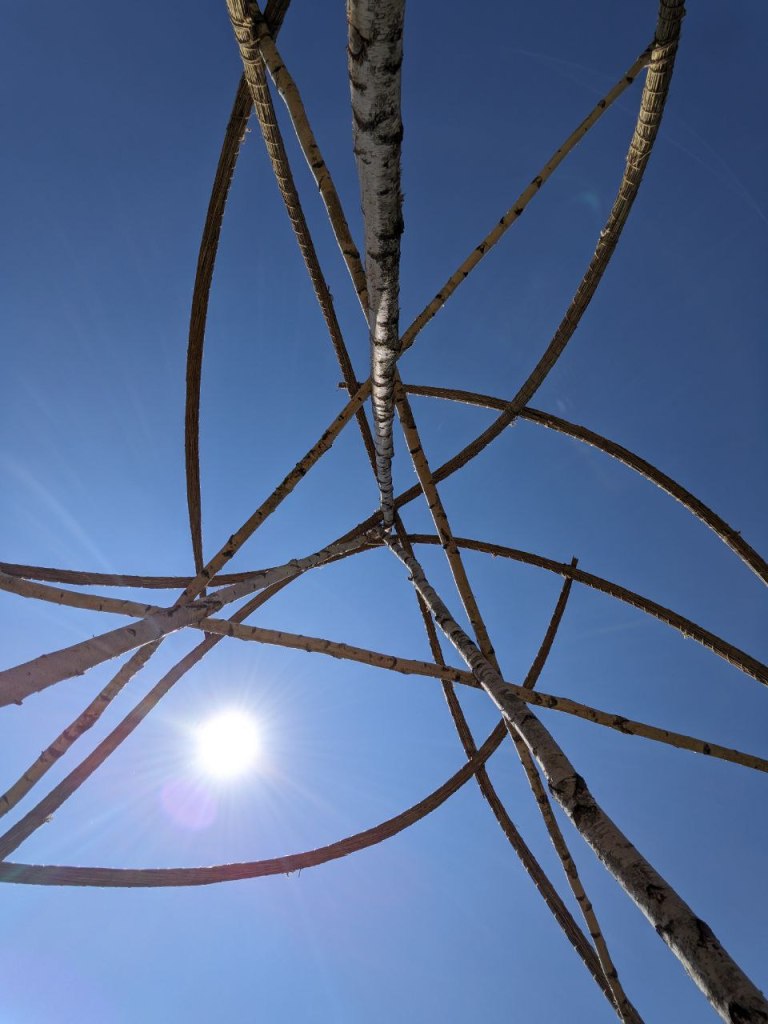
    In combination with my previous experience working with bamboo, I was able to successfully create some pretty nice elements (about 20 cm diameter) which were both rigid enough to hold their structure but had enough tensile strength to create organic curves which worked really well both as a running motif for almost all the beautiful stage structures at Waha festival, as well as my own art installation.

    More details about the art installation: an ethereal, alien-like cocoon, set in a field with internal lighting so it glowed at night and you could stumble across it. it had a secret entrance in the back and could fit about 10 people. I made it with the reed beams and bent birch trees (learned a cool technique for this from a norwegian friend on site). the fabric was a cotton poly blend, which I stitched onto the rope spiralling around the reed beams so that the end effect was almost marine animal-like.

  • Fusion

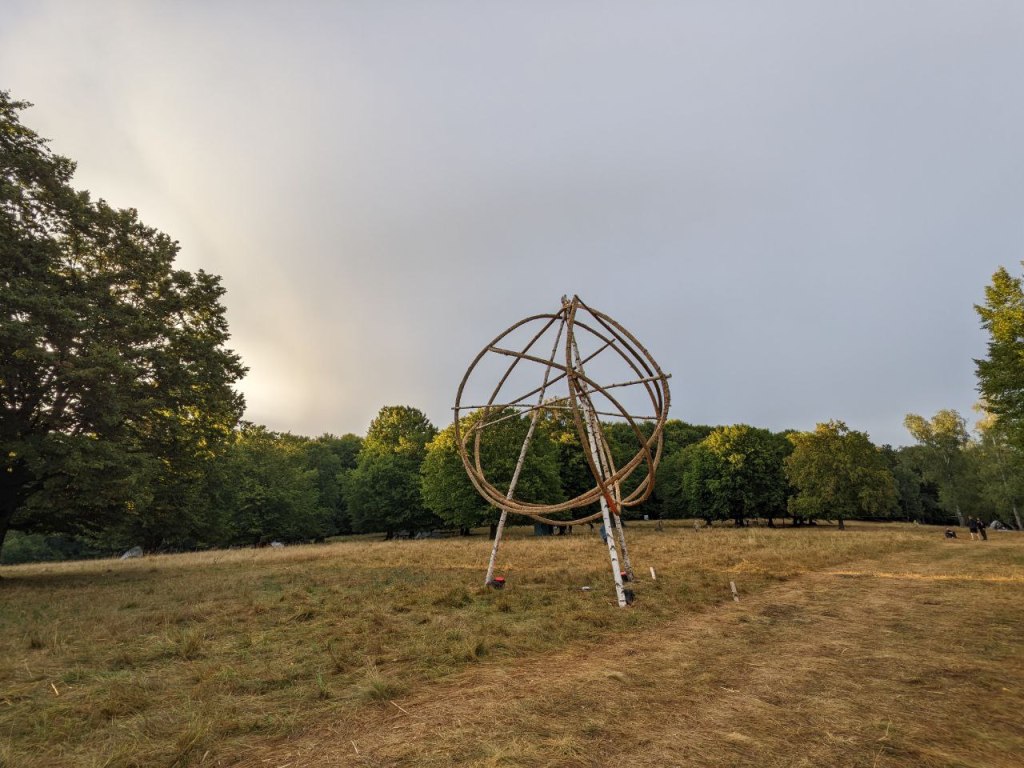
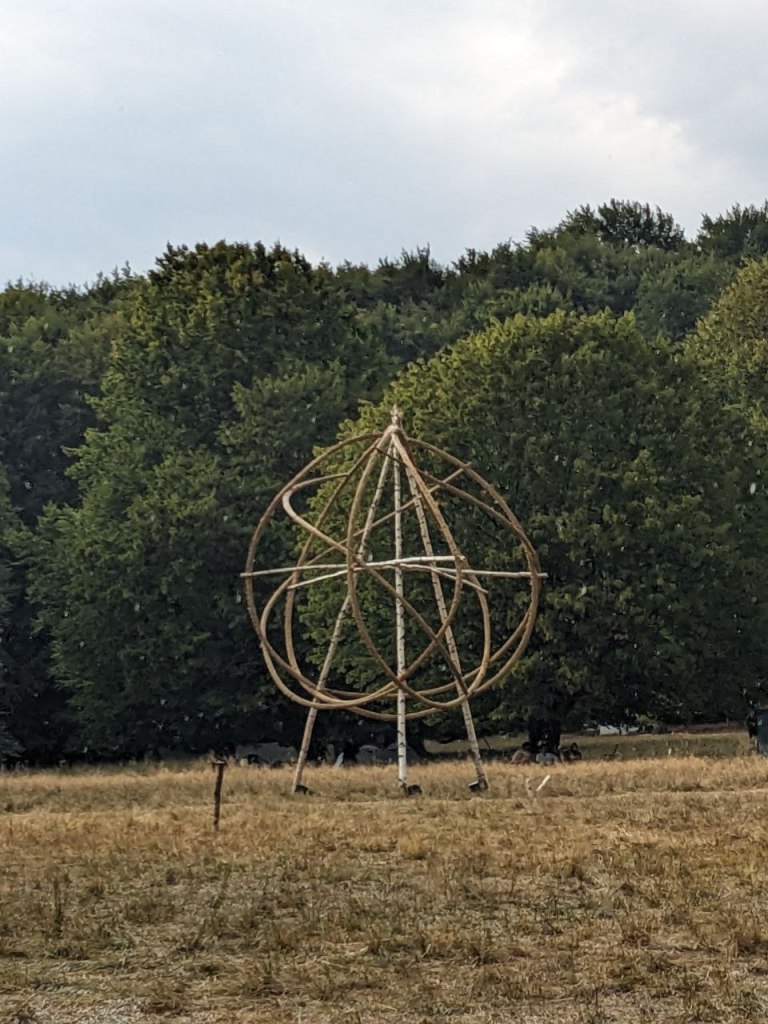
    Reed (phragmites australis), white birch, hemp rope

    Waha Festival, Romania

    I didn’t know that much about Romania before I arrived for the first time last year. I could point at it on a map: a huge country still covered by large swathes of primeval forest — one of the last rare places in Europe where you can still walk among the same trees that have existed without disturbance since the ice ages. And of course, Transylvania has been made famous (at least in the English speaking world) through movie magic into a land of vampires and exotic, primal mysticism.

    This year, I wouldn’t be able to say that I’ve experienced enough of Romania to say I truly know the country and the culture, but what I do know is that I feel so grateful to have been given the trust and support to make my biggest solo installation yet, and most importantly, to have been gifted the time and space to understand just a little bit more of this beautiful land, where the identities and cultural backgrounds of the people are as diverse and colourful as its landscapes.

    Some impressions:

    I think every culture has its own special way it gathers to celebrate, or just to come together, so that when you go to such a gathering you understand that the people are pros at it, and that these ways of gathering— the South African braai, the Louisiana gumbo, the Taiwanese night market— have a special vibe and feeling that represent something difficult to articulate in words.

    For me, the Romania of Wahaland is a bonfire culture. We woke with the morning filtering through the birch trees, a kind of light and fresh green that mixed with the early mist and smoke curling from the remnants of last night’s fire and gave each start of the day an ethereal, ephemeral feeling of time standing still. The nights came on slowly, often with a watercolour sunset fading into black, and then light again from the stars and the moon and the Milky Way washing over our heads.

    Sipping on homemade palinka and wine out of bottles from someone’s father, someone’s sister, someone’s aunt, a bowl of hot ciorbă, mămăligă, and playing paprika 🌶️ spice roulette. Passing joints, passing time, the kind of time that was filled with laughter and shit talk, moments of raw vulnerability and flaring tensions, and the warm and deep kind of silence shared among people who have worked together all day long under a blazing hot summer sun, who come together at the end of the day to share a moment before rest.


    Sitting around the fire, I felt like I could hear the history of humans meeting other humans across the European continent embedded in the sounds of the language flowing around me. Little bubbles of Hungarian, Moldovan, and Roma language. In the Romanian language itself, words like cartof (kartoffel: German), potato. Portocale (portokalia: Greek), orange. Ciorbă (çorba: Turkish), the soup. The chef named Liviu asks the young girl if she’s been keeping an eye on the birthday cake she’s been put in charge of in the oven, and she replies “Da (da: Russian), Chefu”. But also, the sound of a language uniquely its own — a certain resonant quality of sound delivered from the chest, as opposed to the head, or mouth, as we clinked bottles and said to each other, “stai liniștit (don’t worry, relax),” “noroc şi sănătate (luck and good health)”.